O S A K A
ライフライン
ライフライン展 記録集
完成のご案内


【ライフライン展 記録集完成のご案内】
2025年9月12日(金)から10月5日(日)まで、大阪府茨木市福祉文化会館にて開催された展覧会「ライフライン」(キュレーション:国立国際美術館 学芸員・福元崇志)の記録集が、このたび完成いたしました。
展覧会の記録写真や、企画者である福元崇志氏のテキストをはじめ、出展アーティスト全員のテキスト、さらに大島賛都氏(アーツサポート関西 チーフプロデューサー/学芸員)による寄稿など、盛りだくさんの内容となっています。
ライフライン
会 場:茨木市福祉文化会館(オークシアター)
会 期:2025年9月12日 (金) – 10月5日 (日)
ライフライン Insta:https://www.instagram.com/lifeline_oaktheater/
主 催:公益財団法人茨木市文化振興財団
後 援:茨木商工会議所、茨木市観光協会
W E B:https://www.ibabun.jp
企 画:福元 崇志(国立国際美術館)
事務局:田中 勇輝(公益財団法人茨木市文化振興財団)
編 集・デザイン:One Art Project
アーティスト
井澤 茉梨絵 Marie IZAWA
稲垣 元則 Motonori INAGAKI
今井 祝雄 Norio IMAI
勝木 有香 Yuka KATSUKI
国谷 隆志 Takashi KUNITANI
田中 真吾 Shingo TANAKA
中屋敷 智生 Tomonari NAKAYASHIKI
松井 智惠+O JUN Chie MATSU I+O JUN
◻️ 中屋敷 テキスト
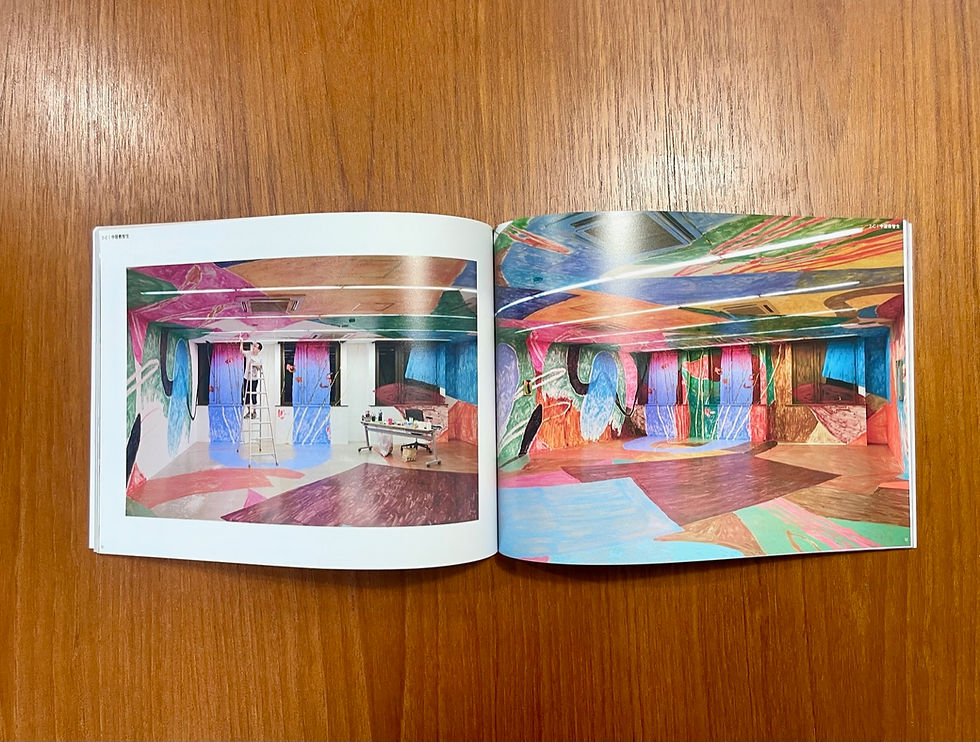
2025年6月28日から7月13日まで、茨木市福祉文化会館全館を会場に開催された「ICAW:Ibaraki Contemporary Art Weeks」において、わたしは2階の一室を使用し、壁や天井、床、窓に至るまで、空間全体を絵画として構成する公開制作を行った。普段はキャンバスに油彩やアクリル、マスキングテープなどを用いた抽象絵画を制作しているのだが、なぜ本展では「部屋そのものを絵画」として捉える試みに至ったのか。その背景には、この会場が翌年に解体を控えていたという事情がある。
会場の下見の際、わたしに割り当てられたのは、昭和の面影を残したやや癖のある空間だった。単に絵画作品を展示するだけではこの場の空気感を活かしきれないと感じると同時にいずれ取り壊される運命にあるからこそ、制約から解き放たれた展示ができるのではないかという直感があった。その瞬間、空間全体をキャンバスに見立て、この時にしか出会えない絵をこの場所に直接刻み込みたいという衝動が湧き上がった。わたしは茨木市の担当職員にその構想を相談し、部屋全体の使用を提案したところ、幸いにも快諾を得て実現に至った。
こうして始まった公開制作は、自分にとってはこれまでにない規模の挑戦であったにもかかわらず、不思議と身構えることなく自然体のまま制作に臨むことができた。筆跡は壁から天井へ、さらに床へと広がり、空間全体が呼吸するように変化していった。
ある日、いつものように脚立に登り、天井へ筆を走らせていたとき、茨木市文化振興財団の田中勇輝氏が、国立国際美術館学芸員の福元崇志氏を伴って会場を訪れた。筆を止めて脚立から降りたわたしに挨拶を済ませたあと、福元氏はこう語りかけた。「9月に同じ会館で開催予定の自分のキュレーションによる展覧会『ライフライン』に参加し、隣室に続くかたちで制作を行ってほしい」。これまでの取り組みを発展させる新たな機会になると感じたわたしは、その場で参加を引き受けた。前置きが長くなったが、以上が本展「ライフライン」に参加することになった経緯である。
「ライフライン」展では、「ICAW」で制作した部屋の隣にある、より広い空間を使用した。9月から会場に入り、まず前作の部屋と新しい部屋を隔てる壁に黒の塗料を走らせた。二度目の試みであったこともあり、筆の動きはより自然に、勢いを増していった。前回と同様に事前の構想を持たず、現場で一筆ずつ色面や線を重ねながら、絵画と空間、そして窓から差し込む光と対話を続けた。絵の内と外、そして公開制作に立ち会う鑑賞者のまなざしが溶け合い、互いに包み、包まれ合うような関係が生まれていく。展覧会が終わる前日、仕上げの段階で、最後まで何色を塗るか決めかねていた箇所があった。隣の部屋から歩きながらその色を思案していたとき、ふと、最初に塗りはじめた黒の行き着く先がまだないことに気づいた。「そうか、最初の黒が最後を締める」。その瞬間、すべてがひとつにつながったのである。
「ライフライン」という言葉には、電気や水道、通信といった社会的インフラを超えた意味の広がりがある。それは、生きるために目に見えないかたちで張り巡らされた連続と循環であり、人と世界を二項対立的に分ける境界ではない、両者を結ぶ「縁」のようなものがイメージとして浮かぶ。わたしにとって、それは呼吸のように「吸う」と「吐く」を繰り返しながらひとつになり、この世界とのつながりを保つものでもある。その自覚のもとでわたしは、「主観」と「客観」が対立する以前の両者が未分化な状態、すなわち思慮や判断を介さない「あるがままの経験」に可能性を見ている。描くという行為も、絵画も、空間も、光も、時間も、鑑賞者も、記憶も、そのいずれかが主役になるのではなく、互いに包みつつ包まれ、包まれつつ包む関係のなかにある。その呼吸の中で、絵画は「生」としてのつながりを紡ぎ出し、一つの「ライフライン」として生成し続けているのである。
――――――――――
[Announcement: Completion of the “Lifeline” Exhibition Catalog]
The catalog for the exhibition “Lifeline” (curated by Takashi Fukumoto, Curator at the National Museum of Art, Osaka), which was held at the Ibaraki City Welfare and Cultural Hall in Osaka Prefecture from Friday, September 12 to Sunday, October 5, 2025, has now been completed.
The publication is packed with content, including exhibition photographs, texts by curator Takashi Fukumoto, texts by all participating artists, and a contribution by Sando Oshima (Chief Producer/Curator, Arts Support Kansai).
Lifeline
Venue: Ibaraki City Welfare and Cultural Hall (Oak Theater)
Dates: September 12 (Fri) – October 5 (Sun), 2025
Lifeline Instagram: https://www.instagram.com/lifeline_oaktheater/
Organizer: Ibaraki City Cultural Promotion Foundation (Public Interest Incorporated Foundation)
Supported by: Ibaraki Chamber of Commerce and Industry, Ibaraki City Tourism Association
Website: https://www.ibabun.jp
Curator: Takashi Fukumoto (The National Museum of Art, Osaka)
Secretariat: Yuki Tanaka (Ibaraki City Cultural Promotion Foundation)
Editing & Design: One Art Project
Artists
Marie IZAWA
Motonori INAGAKI
Norio IMAI
Yuka KATSUKI
Takashi KUNITANI
Shingo TANAKA
Tomonari NAKAYASHIKI
Chie MATSU I+O JUN
◻️ Text by Nakayashiki
From June 28 to July 13, 2025, “ICAW: Ibaraki Contemporary Art Weeks” was held throughout the Ibaraki City Welfare and Cultural Hall. For this event, I utilized a room on the second floor to conduct a public creation process in which I treated the entire space—from the walls and ceiling to the floor and windows—as a single painting. While I usually create abstract paintings on canvas using oil paints, acrylics, and masking tape, why did I decide to treat “the room itself as a painting” for this exhibition? The reason lies in the fact that this venue was scheduled for demolition the following year.
When I visited the venue for a preliminary inspection, I was assigned a somewhat quirky space that retained a vestige of the Showa era. I felt that simply displaying paintings would not fully capture the atmosphere of the place, but at the same time, I had an intuition that precisely because it was destined for demolition, I could create an exhibition free from constraints. In that moment, an impulse welled up within me to treat the entire space as a canvas and to directly imprint a painting—one that could only be encountered at that specific time—onto this place. I discussed this concept with the staff member in charge at Ibaraki City and proposed using the entire room. Fortunately, they readily agreed, and the project came to fruition.
Although this public creation process, which began in this way, was a challenge on a scale I had never experienced before, I was strangely able to approach the work naturally, without feeling any pressure. My brushstrokes spread from the walls to the ceiling and then to the floor, and the entire space transformed as if it were breathing.
One day, as I was climbing the stepladder as usual and running my brush across the ceiling, Mr. Yuki Tanaka of the Ibaraki City Cultural Promotion Foundation visited the venue accompanied by Mr. Takashi Fukumoto, a curator at the National Museum of Art, Osaka. After I stopped painting, climbed down from the stepladder, and exchanged greetings, Mr. Fukumoto spoke to me. “I’d like you to participate in ‘Lifeline,’ an exhibition I’m curating at this same venue in September, and create a work that continues into the adjacent room.” Sensing that this would be a new opportunity to build upon my previous efforts, I accepted the invitation on the spot. This has been a long preamble, but the above is the background to this exhibition, “